|
|
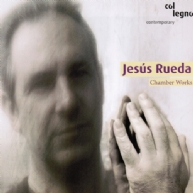
| One of the mysteries surrounding Jesús Rueda is the question how he was able to find a voice of his own, the various influences to which he was exposed during his development as a composer notwithstanding. He bid farewell to the constructivist rigor of Francisco Guerrero, and his pieces to do not immediately betray influences by Luis de Pablo, Giacomo Manzoni and Luigi Nono. Characteristic of his compositions are fast tempos, present in “slower” parts as brisk figurations, his sense of harmony and consonance (which is not to be mistaken for tonality!) and his fondness for high registers and transparent instrumentations. Rueda, an excellent pianist, puts his pianistic expertise to use in Cadenza with breathtaking sections and a technically skilled ensemble. In Ítaca, his attention turns to the constant play of forces between piano and ensemble, a game from which both players, utterly exhausted, eventually have to resign. But center stage on the present recording belongs to Mas la noche, which is based on a poem by the Andalusian poet Ibn al Zaqqaq. Rueda ingenuously transforms the “chase through the night” described therein into sound and energy. |
1CD | Contemporary | Special Offers |
|
|
|
| Recommendation |
|
|
|
|
Lukas Ligeti created a unique word-sound document in the context of the history of Polish Jews. Touching and absolutely worth listening!  |
|
|
|
|
|
| IOSIS is a scenic-musical collage, which deals with love, passion, force, pain and death and fuses new with old music to an expressive entity! |
|
|
|
|
|
| The master of nasal sounds: Matthias Arter has freed the oboe from the clutches of ordinary classical music and catapulted it into the 21st century. |
|
|