|
|
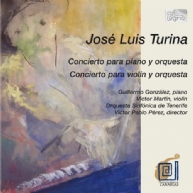
| When composing his Concierto para piano y orquesta, the Spanish composer José Luis Turina was particularly interested in the “non-symphonic nature of the piano” because of the instrument’s special “sonic disparity”, which, say, a violin lacks. After all, the violin can always return to the fold of the full orchestra, whereas the piano soloist never leaves the limelight. It should then be no surprise that the three (through-composed) movements of the concerto with its contrasting musical forms and the convoluted stretta in the end confront the pianist with extraordinary challenges. In his Concierto para violín y orquesta, Turina treats the solo instrument in a great variety of ways. In the first of the three movements, he establishes the contrast between noise and music as the principal building block. The second movement, whose main section is composed in twelve-tone technique, has the character of a scherzo. The original contrast returns in the finale, and, “as a last gesture of humility, the soloist lowers the bow and returns to the orchestra: He thumps and hammers on his instrument as the orchestra gradually retreats, leaving him alone in this world of sound yet unknown to him.” (Turina) |
1CD | Contemporary | Orchestral | Special Offers |
|
|
|
| Recommendation |
|
|
|
|
“So it is a matter of distributing the signs on the paper and weighing them against each other to create a kind of dance." (Gerhard Amanshauser)  |
|
|
|
|
|
| Xiaoyong Chen assisted by the E-MEX-Ensemble and the Chai Found Music Workshop, conducted by Christoph Maria Wagner. A co-production with Deutschlandfunk. |
|
|
|
|
|
| “Its eyes are wide open, its mouth is agape, and its wings are stretched out. The angel of history must look like this. It has turned its face toward the past…“ |
|
|